

The Evolution of Lumens: Why Wattage No Longer Defines Solar Street Light Brightness
2026-05-11
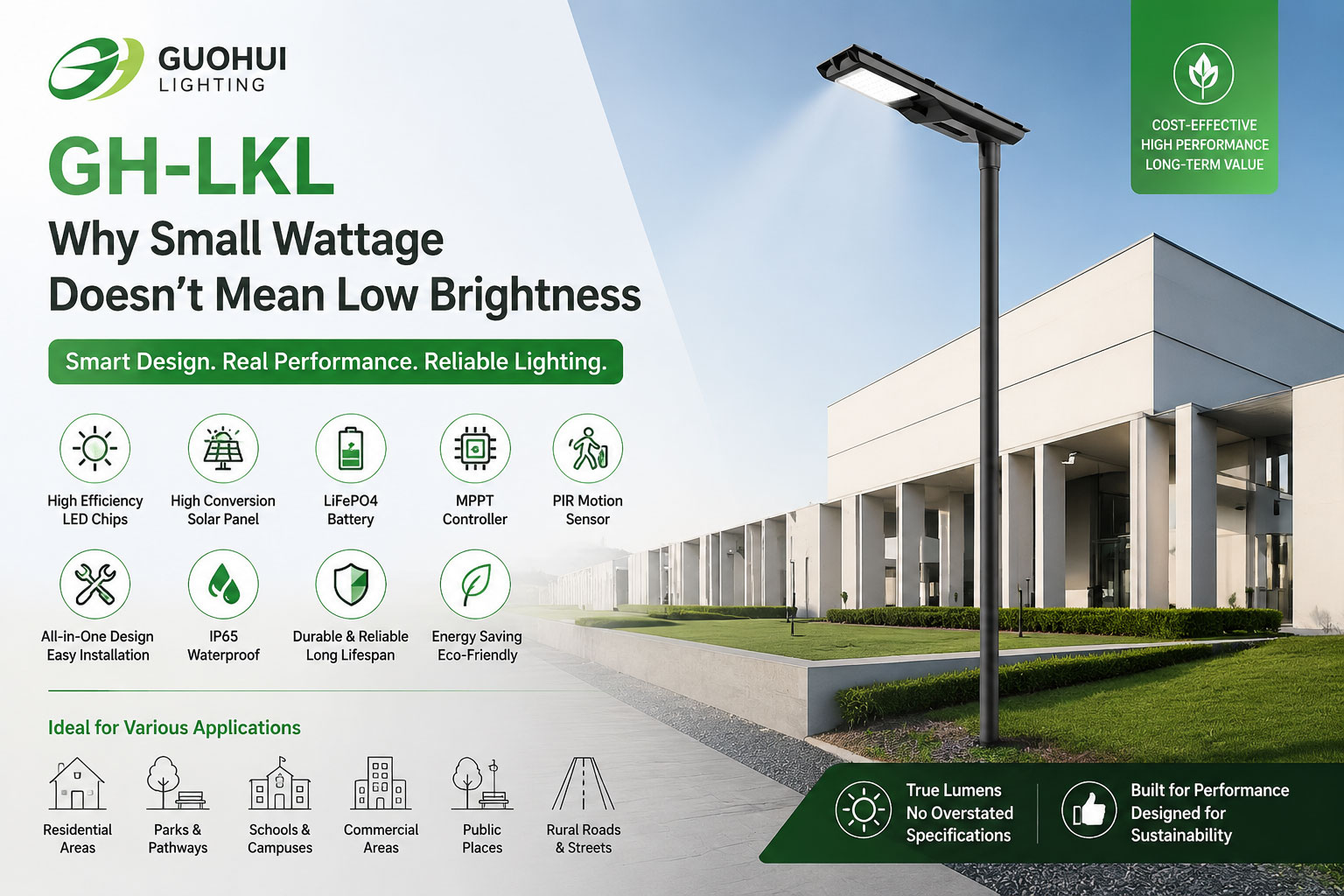
For decades, consumers and project managers alike operated under a simple, universal rule when purchasing lighting: the higher the wattage, the brighter the light. A 100-watt incandescent bulb was invariably brighter than a 40-watt one. However, as the global outdoor lighting industry undergoes a massive transition toward sustainability—driven by solar power and Light Emitting Diode (LED) technology—this old rule has become completely obsolete. In modern solar street lighting, small wattage does not necessarily mean low brightness. Understanding this shift requires a look into the physics of luminous efficacy, smart energy management, and the distinct mechanics of solar-powered systems.
To understand why wattage is no longer a reliable measure of brightness, one must understand what a watt actually represents. A watt is a unit of electrical power consumption, measuring how much energy a lamp draws from its power source. It does not measure the actual visual output. The true metric for brightness is the lumen, which quantifies the total amount of visible light emitted by a source.
The relationship between these two metrics is known as luminous efficacy, measured in lumens per watt (lm/W). Legacy lighting technologies, such as High-Pressure Sodium (HPS) or metal halide lamps traditionally used in street lighting, have relatively low efficacy, often converting a massive amount of energy into wasted heat rather than light. In contrast, modern industrial LED chips achieve unprecedented efficacy levels.
For instance, an older street light might require 150 watts to produce 13,000 lumens. A high-efficiency modern LED street light can easily generate that same 13,000 lumens while drawing only 70 to 80 watts. Therefore, a low-wattage LED fixture can effortlessly outperform a high-wattage traditional fixture in pure brightness.
In commercial and municipal solar street lighting, efficiency is everything. Because these systems rely entirely on stored battery power, engineers do not want high-wattage fixtures that drain energy rapidly. Instead, the goal is to maximize brightness while minimizing the power draw.
High-quality solar street lights achieve this through several advanced components:
Premium LED Chips: High-end architectural and municipal solar lights utilize top-tier LED chipsets (such as Bridgelux, Cree, or Osram) paired with high-performance optical lenses. These systems can achieve efficacies exceeding 180 to 200 lm/W.
Precision Optics: Traditional street lights scatter light in all directions, wasting energy illuminating the sky or empty fields. Modern solar street lights use precise asymmetric lenses to direct every single lumen precisely onto the roadway or sidewalk. This means a lower-wattage solar light can provide better, brighter lux levels on the ground than a poorly designed, high-wattage alternative.
Another reason small wattage does not equate to low brightness in solar engineering is the implementation of Intelligent Working Modes. Traditional grid-tied street lights run at 100% power all night long, wasting immense amounts of energy when streets are completely empty. Solar street lights utilize Maximum Power Point Tracking (MPPT) controllers and smart Battery Management Systems (BMS) to regulate power intelligently.
Through customized time-dimming profiles or integrated microwave motion sensors, a solar street light can operate at a highly efficient lower wattage (e.g., 20W or 30W) during midnight hours, yet still deliver the crisp, high-visibility illumination required for safety. When a vehicle or pedestrian approaches, the system can instantly scale up performance. Thus, the light provides optimal brightness exactly when needed, without demanding a high, continuous wattage draw that would require massive, cost-prohibitive batteries and solar panels.
The belief that small wattage equals low brightness is a relic of the traditional lighting era. In the realm of modern solar street lighting, wattage is simply a measure of how much energy the LED source consumes, whereas lumens and optical design dictate how brightly the road is illuminated. By pairing high-efficacy LED chips with intelligent controllers and precise optical distribution, a low-wattage solar street light can easily deliver superior, reliable brightness. For municipal planners, engineering contractors, and global distributors, focusing on luminous efficacy and ground-level lux—rather than raw wattage—is the key to selecting high-performing, sustainable infrastructure.
Product
Project
About
Contact us
7F,Bldg. A,Hytera Park,3 Baolong 4th Rd,Longgang,Shenzhen,China