

How Are Battery Sizing and Solar Panel Sizing Connected in Solar Street Lights?
2026-11-02
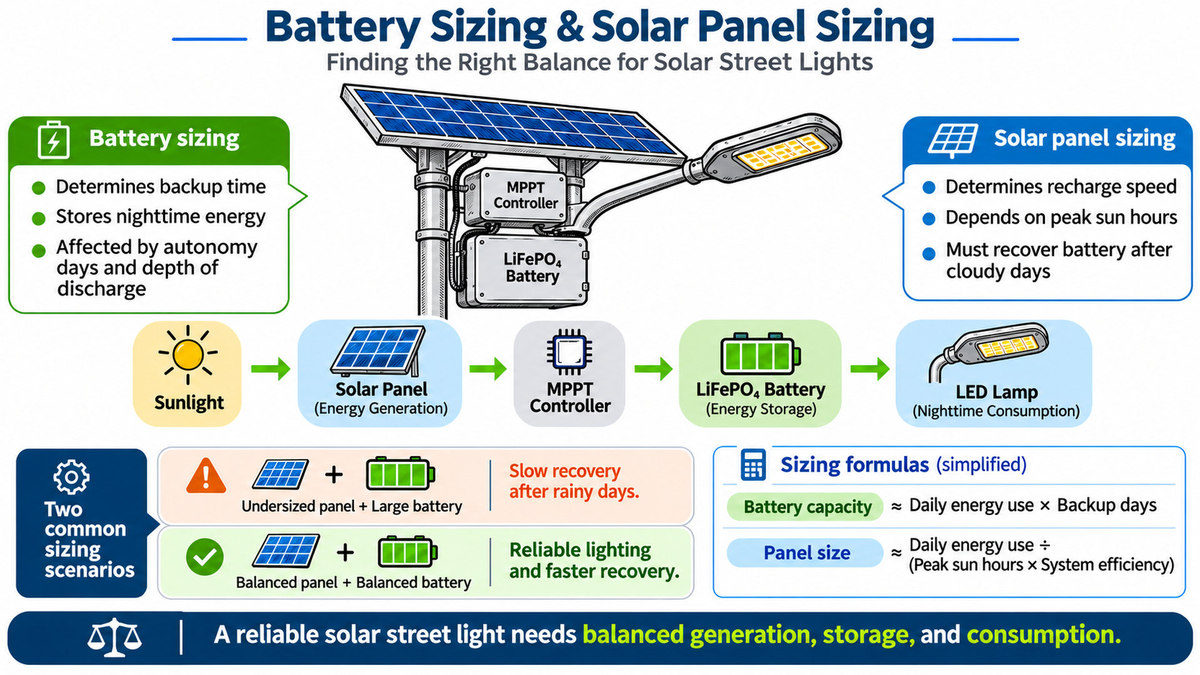
When purchasing solar street lights, many buyers naturally focus on three specifications: LED wattage, battery capacity, and solar panel power.
A common assumption is that a bigger battery guarantees longer lighting hours, while a larger solar panel automatically means better performance.
However, the real secret to reliable solar street lighting lies in balancing energy generation, energy storage, and energy consumption.
An oversized battery paired with an undersized solar panel may struggle to recharge after several cloudy days. Conversely, a powerful solar panel with insufficient battery storage cannot provide the required nighttime illumination.
Understanding this relationship is essential for designing efficient, reliable, and cost-effective solar street lighting systems.
A solar street light is essentially a small, independent solar power system.
Its components perform three different functions:
Solar panel: Generates electricity during daylight hours.
LiFePO4 battery: Stores electricity for nighttime operation.
LED luminaire: Consumes stored energy to provide illumination.
Think of the battery as a water tank and the solar panel as the pump filling it.
A larger tank can store more water, but if the pump is too small, it takes much longer to refill. Similarly, a powerful pump is of limited value if the tank cannot store enough water for nighttime demand.
The key distinction is that solar panel capacity is measured in watts (Wp), while battery energy capacity is measured in watt-hours (Wh).
These two values are related, but they are not interchangeable.
Battery sizing begins with the actual energy consumed by the LED luminaire—not simply its advertised wattage.
Consider a hypothetical 60W solar street light operating for 12 hours each night with an intelligent dimming schedule.
| Operating period | Brightness | Energy |
|---|---|---|
| First 3 hours | 100% | 180 Wh |
| Next 5 hours | 50% | 150 Wh |
| Final 4 hours | 25% | 60 Wh |
| Total | 12 hours | 390 Wh |
Assuming that LED electrical power scales proportionally with the selected dimming levels, the lamp consumes approximately 390 Wh per night.
Allowing an additional 10% for driver, control, and wiring losses gives an estimated daily battery energy requirement of 430 Wh.
Now suppose the project requires two nights of operation without meaningful solar charging.
Required usable battery energy:
430 Wh × 2 = 860 Wh
The nominal battery capacity must be larger because batteries should not necessarily be discharged to 100% of their rated capacity.
For example, a 12.8V, 120Ah LiFePO4 battery has:
12.8V × 120Ah = 1,536 Wh nominal capacity
If the design permits 80% depth of discharge (DoD):
1,536 Wh × 80% = 1,229 Wh usable energy
Under these simplified assumptions, this battery provides enough energy for the two-night target, with some additional reserve.
However, actual battery selection must also account for temperature, aging, discharge efficiency, and the battery management system's operating limits.
Important: The 80% DoD used here is an illustrative design assumption, not a universal requirement for all LiFePO4 batteries.
Once the battery requirement is understood, the next question is:
Can the solar panel replenish the energy consumed each night?
A simplified sizing formula is:
Solar Panel Power (Wp) = Daily Energy Requirement (Wh) ÷ (Peak Sun Hours × System Efficiency)
Suppose the installation location receives four equivalent peak sun hours per day during the design period.
Assuming a 75% overall PV-to-battery energy factor to account for solar-panel operating conditions and charging-system losses:
430 Wh ÷ (4 × 0.75) = 143 Wp
This is the approximate minimum panel rating required to replace one night's energy consumption under the stated assumptions.
A 200Wp solar panel would theoretically generate:
200W × 4h × 0.75 = 600 Wh per day
After replacing the nightly consumption of 430 Wh, approximately 170 Wh remains available for restoring previously depleted battery energy.
This sounds reasonable—but what happens after several rainy days?
This is where many solar street light designs encounter difficulties.
Suppose the battery has supplied 860 Wh across two nights with negligible solar charging.
With a 200Wp panel, the estimated daily energy surplus is only 170 Wh.
Recovering that depleted energy could therefore take approximately:
860 Wh ÷ 170 Wh/day = 5 sunny days
Now consider upgrading the panel to 300Wp while keeping the same battery and lighting schedule.
Estimated daily solar energy:
300W × 4h × 0.75 = 900 Wh
After deducting the normal nightly demand:
900 Wh − 430 Wh = 470 Wh surplus per day
The battery could theoretically recover the same 860 Wh deficit in approximately two sufficiently sunny days.
This example illustrates a critical principle:
Battery capacity determines how much energy can be stored, while solar panel capacity determines how quickly that energy can be replenished.
A larger battery without sufficient charging capacity may provide additional backup initially but remain partially discharged for extended periods.
These examples are simplified energy-balance calculations, not specifications for a particular Guohui Lighting model. Actual recovery also depends on charging limits, weather, and battery state of charge.
Another frequently overlooked factor is the relationship between LED power and the actual lighting schedule.
Consider the same 60W solar street light.
If it operates at full power for 12 hours, its nightly LED energy consumption becomes:
60W × 12h = 720 Wh
Including the same 10% allowance, the demand rises to approximately 792 Wh.
Under the earlier solar assumptions, a 200Wp panel generates only 600 Wh daily—creating an estimated daily energy deficit.
This means the battery would gradually lose charge even during otherwise normal sunny conditions.
Intelligent lighting controls can significantly reduce energy consumption while maintaining useful illumination.
Depending on project requirements, these may include:
Time-based dimming schedules
PIR or microwave motion detection
Automatic dusk-to-dawn operation
Adaptive power management
However, energy-saving strategies must never compromise required road illumination, uniformity, or applicable lighting standards.
For municipal projects, lighting quality and energy efficiency must be considered together.
There is no universal battery-to-solar-panel ratio suitable for every solar street light.
A reliable design should consider the following factors.
1. Local solar irradiation
Solar energy availability varies significantly between countries, seasons, and installation sites.
A system designed for consistently sunny conditions may perform poorly in regions with prolonged rainy seasons.
Panel sizing should consider the critical low-sunlight period rather than relying only on annual average sunshine.
2. Required backup days
Projects requiring three to five nights of backup generally need more usable battery storage than projects designed for one or two nights, assuming identical lighting loads.
However, the required panel capacity also depends on how quickly the battery must recover after extended cloudy weather.
3. Actual LED energy consumption
Two lights advertised as 100W may have very different nightly energy requirements because of their dimming schedules, driver characteristics, and operating hours.
Rated wattage alone is insufficient for proper system design.
4. Temperature and environmental conditions
High solar-cell temperatures reduce photovoltaic output, while battery performance may change under extreme temperatures.
Dust accumulation, shading, and seasonal weather conditions can further affect daily energy generation.
5. Controller and battery compatibility
An MPPT solar charge controller helps manage solar energy conversion and battery charging.
The controller must be correctly matched to the solar panel's electrical characteristics, the battery voltage, and the permitted charging current.
Battery protection and proper charging parameters are equally important for long-term reliability.
At Guohui Lighting, we believe reliable solar lighting begins with proper system engineering rather than simply selecting the largest available components.
As a professional solar street light manufacturer with an independent LiFePO4 battery pack production facility, we can coordinate battery design with the overall lighting system.
Our engineering and manufacturing capabilities include:
Customized LiFePO4 battery pack configurations
Solar panel and battery capacity matching
Intelligent MPPT charging and power management
LED operating schedule optimization
Battery assembly, aging tests, and quality inspections
OEM/ODM solutions for different project requirements
Whether customers select an all-in-one solar street light, a split-type system, or a heavy-duty solution, the battery, solar panel, controller, and LED luminaire must work as one balanced system.
Our goal is not simply to offer larger specifications, but to provide appropriately engineered solar lighting solutions for real-world operating conditions.
The relationship between battery capacity and solar panel sizing is fundamental to the performance of every solar street light.
An appropriately sized battery provides sufficient nighttime energy storage. A properly matched solar panel replenishes that energy within the available daylight hours.
Neither component can compensate indefinitely for poor system design.
For project contractors, distributors, and municipal buyers, the most important question is not:
"How big is the battery?"
It is:
"Can the complete solar lighting system deliver the required illumination, every night, under the actual conditions of the project?"
That is the difference between impressive specifications and dependable performance.
Looking for a reliable solar street light manufacturer?
Guohui Lighting provides customized solar street lighting solutions supported by in-house LiFePO4 battery production, engineering expertise, and strict quality control.
Guohui Leads the Way, Lighting the Future.
Website: www.szguohui.com
Email: info@szguohui.com
Product
Project
About
Contact us
7F,Bldg. A,Hytera Park,3 Baolong 4th Rd,Longgang,Shenzhen,China