

Solar Street Lighting in 2026: From Energy Saving to Smart Infrastructure
2026-09-01
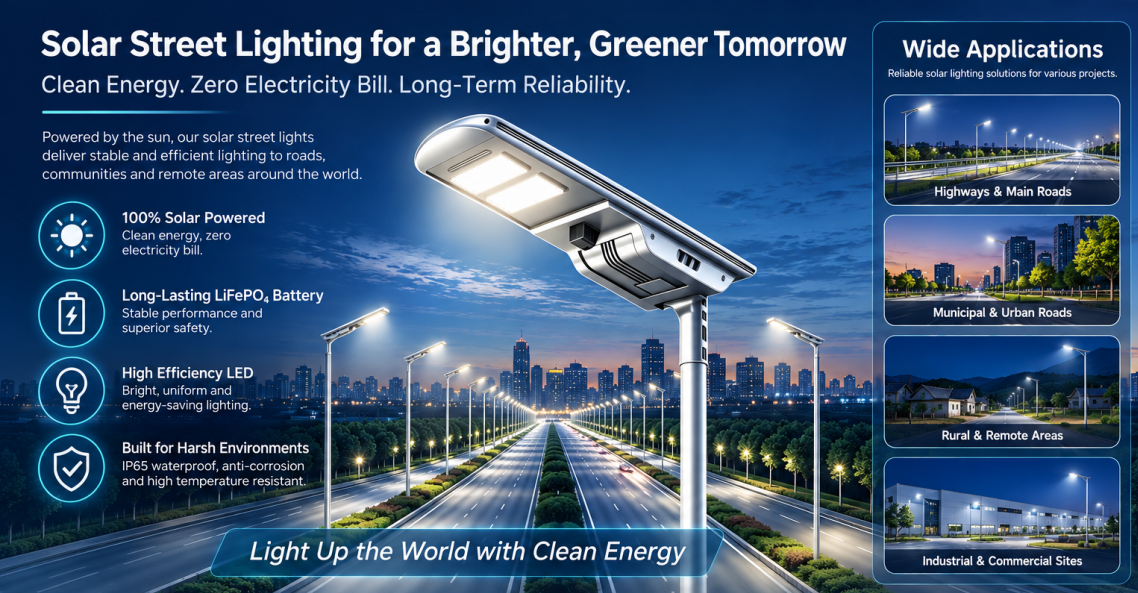
Solar street lighting is entering a new stage.
It is no longer simply an alternative to conventional grid-connected street lights. Around the world, governments and infrastructure developers are increasingly looking at solar lighting as a practical solution for energy savings, grid independence, public safety and sustainable infrastructure.
Recent projects in Asia and the continued development of the global off-grid solar industry show that this trend is accelerating.
For manufacturers, contractors and project developers, the question is no longer simply “Do we need solar street lights?”
The more important question is:
“What kind of solar lighting system can deliver reliable performance for the next 5, 10 or even 15 years?”
One of the latest examples comes from Perak, Malaysia.
On September 1, 2026, Malaysia's Perak state announced that 700 solar-powered street lamps had been approved for installation under the Solar Madani programme. The project is intended to improve public safety while reducing reliance on the conventional electricity grid.
This is significant because it demonstrates a shift in how governments view solar street lighting.
Solar lighting is not being adopted only because it is renewable.
It is also being considered because it can help address energy costs, infrastructure limitations and the need to provide lighting in areas where extending grid infrastructure may be difficult or expensive.
And Malaysia is not an isolated case.
In Cebu City, Philippines, a project launched in June 2026 involves 350 solar-powered street light poles along Governor Cuenco Avenue, with the city expecting annual electricity savings of approximately ₱4.2 million. The project also includes technical assistance and a minimum five-year warranty.
These projects tell us something important:
Solar street lighting is becoming an infrastructure investment, not simply a lighting product purchase.
The global solar street lighting market is also continuing to expand.
One recent market analysis estimates the global solar street lighting market at approximately US$13.67 billion in 2026, with the market projected to reach US$33.26 billion by 2034.
But market growth alone does not guarantee success for every manufacturer.
As more suppliers enter the industry, buyers are becoming more careful.
They are asking:
Is the claimed wattage real?
How many lumens does the lamp actually produce?
What is the real battery capacity?
What battery chemistry is being used?
How many rainy days can the system support?
How efficient is the solar panel?
What happens after several years outdoors?
Is there a proper test report?
Can the manufacturer support a 500-, 1,000- or 10,000-unit project?
These are the questions that separate a solar lighting product from a professional solar lighting solution.
The technology is also evolving.
Modern solar street lighting is no longer simply:
Solar panel + battery + LED.
A professional system needs to consider the entire energy chain:
Solar Panel → MPPT/PWM Controller → LiFePO4 Battery → LED Module → Optical System → Intelligent Control
Every component affects the final performance.
For example, a high-efficiency LED cannot compensate for an undersized battery.
A large battery cannot solve a poorly designed solar panel system.
And a powerful solar panel does not automatically guarantee reliable lighting during long periods of cloudy weather.
The system has to work as a system.
That is why solar street light design should begin with the actual project requirements—not simply with a nominal wattage.
Another important development is the growing connection between lighting and digital infrastructure.
The broader smart-lighting market is moving toward connected luminaires, sensors, wireless controls, IoT platforms and remote monitoring, particularly in smart-city and municipal applications.
For solar street lighting, this creates new possibilities.
Imagine a municipality managing thousands of solar street lights from one platform.
Instead of waiting for residents to report a failed light, the system could potentially identify abnormal operating conditions remotely.
Instead of every light operating at the same brightness throughout the night, intelligent controls can support different lighting levels depending on traffic, time or environmental conditions.
The future of solar lighting is therefore not simply:
“A lamp powered by the sun.”
It is increasingly:
“An intelligent, independent lighting system.”
For solar street lights, the battery is one of the most critical components.
A lamp may have an excellent LED module and a high-efficiency solar panel, but if the battery cannot reliably store and deliver energy, the entire system will eventually fail to meet expectations.
This is why LiFePO4 battery technology has become increasingly important in modern solar lighting.
At Guohui Lighting, we believe battery quality should not be treated as an afterthought.
We manufacture our own LiFePO4 battery packs and pay attention to the complete battery system—not simply the capacity printed on a specification sheet.
For project customers, the important question is not:
“How many Ah does the battery have?”
It is:
“Can the battery deliver the required lighting performance throughout the project lifecycle?”
Another encouraging sign for the industry came in August 2026, when GOGLA and the International Solar Alliance renewed and expanded their cooperation on off-grid solar.
Their cooperation includes market intelligence, policy, quality standards, local manufacturing and financing, with the goal of accelerating the deployment of off-grid solar solutions.
This matters because the future growth of solar lighting cannot depend only on selling more units.
It also depends on:
Better standards.
Better testing.
Better products.
Better project design.
Better long-term service.
The industry needs manufacturers who are willing to prove what their products can actually do.
For distributors, engineering contractors and government projects, we believe the buying criteria should gradually move away from:
“What is the cheapest price per unit?”
toward:
“What is the real cost of reliable lighting over the entire project lifecycle?”
A low-cost solar street light may look attractive on a quotation.
But if the battery fails early, the LED performance is lower than expected, or the system requires frequent maintenance, the initial saving can quickly disappear.
A professional solar lighting project should therefore consider:
Not just the advertised wattage.
Measured in Wh, not simply an impressive-looking Ah number.
Because energy generation determines how effectively the battery can be recharged.
Especially for high-power LED systems operating in hot climates.
Because lumens alone do not tell you how well a road will actually be illuminated.
The product must be designed for rain, dust, UV exposure, heat and wind.
A good solar street light should be designed with the entire lifecycle in mind.
At Guohui Lighting, we don't believe the future of solar street lighting is about producing the lamp with the biggest number printed on the specification sheet.
We believe it is about producing a system that performs in the real world.
From our solar street light housings and LED modules to our in-house LiFePO4 battery production, we focus on the details that determine long-term performance.
We manufacture all-in-one solar street lights, split-type solar street lights, solar flood lights, solar garden lights and LED high mast lighting solutions for international markets.
And perhaps most importantly:
We believe actual performance should always come before exaggerated specifications.
Because a solar street light doesn't work in a catalogue.
It works outside.
Under the sun.
In the rain.
On highways.
In villages.
In cities.
And night after night, it has only one job:
The latest developments point in one direction:
Solar lighting is becoming more intelligent, more project-oriented and more focused on long-term value.
Government projects in Malaysia and the Philippines are demonstrating the practical benefits of grid-independent lighting.
The wider off-grid solar industry is also reaching new levels of maturity, with GOGLA reporting that affiliated companies sold more than 10 million solar energy kits in 2025, while the sector continues to attract investment and international cooperation.
For us, this is more than market growth.
It is a reminder that solar lighting is becoming part of the world's infrastructure.
And infrastructure deserves something more than a low price.
It deserves reliability.
Product
Project
About
Contact us
7F,Bldg. A,Hytera Park,3 Baolong 4th Rd,Longgang,Shenzhen,China