

How to Choose Solar Street Lights: Look Beyond Wattage
2026-10-10
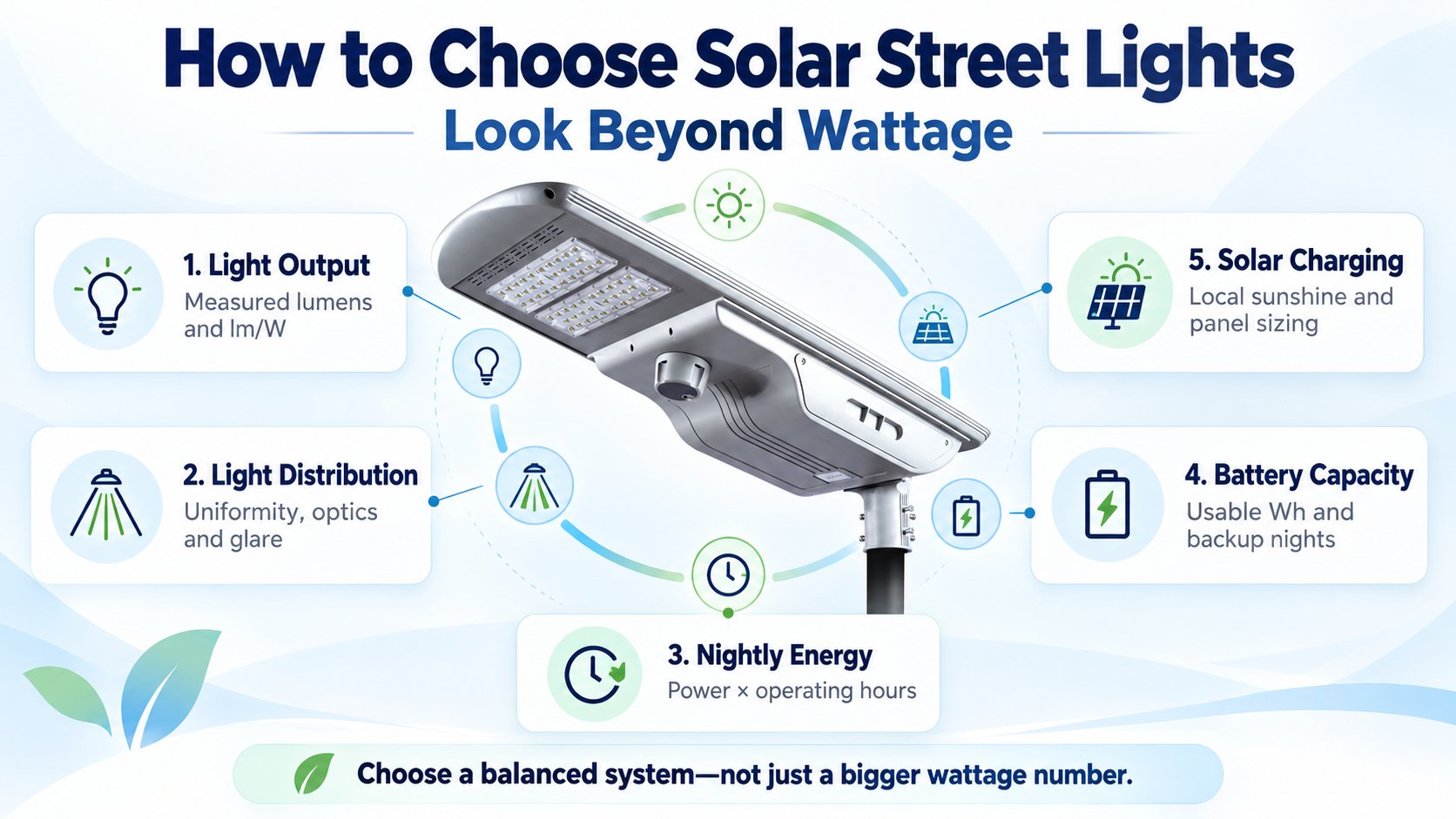
For distributors, contractors and municipal buyers, comparing solar street lights can be difficult. A large wattage number may attract attention, but it does not tell you how much useful light reaches the road—or how long the system can maintain that light.
A reliable purchase starts with five questions: What is the measured light output? Where does the light go? How much energy is consumed each night? Can the battery support that demand? Can the solar panel replenish it?
Watts describe electrical power. Lumens describe light output. Luminous efficacy, measured in lumens per watt (lm/W), shows how efficiently a luminaire converts electrical input into light.
Ask suppliers for the actual operating power, measured luminaire output and test conditions. Confirm that the efficacy figure refers to the complete light fixture, rather than only its LED chips. The U.S. Department of Energy distinguishes LED source efficacy from complete luminaire efficacy because performance depends on how the components work together.
This gives buyers a clearer basis for comparing products than model names or advertised wattage alone.
Two lights with similar lumen output can produce very different results on the same road. Lens design, mounting height, pole spacing and installation angle determine where the light falls.
A bright spot beneath each pole does not necessarily mean the road is evenly illuminated. Buyers should request photometric files and a lighting simulation that evaluates the relevant illuminance or luminance, uniformity and glare requirements.
Department of Energy guidance recommends evaluating product photometry and analysing illumination across the target area using lighting design software and site measurements.
For project quotations, provide the road width, pole height, spacing and required lighting criteria before selecting a model.
“Works all night” can describe several operating modes. A light running at full power for 12 hours requires much more energy than one that dims during quieter periods.
Consider this illustrative schedule for an 80W light:
| Operating period | Assumed power | Energy consumed |
|---|---|---|
| First 4 hours at 100% | 80W | 320Wh |
| Next 2 hours at 50% | 40W | 80Wh |
| Final 6 hours at 30% | 24W | 144Wh |
| Total | 544Wh |
This simplified calculation assumes power scales directly with the dimming percentage. Actual controller settings, driver behaviour and auxiliary consumption should be checked.
At full power for the same 12 hours, the light would consume 960Wh. Both schedules provide 12 hours of operation, but their battery requirements differ substantially.
Amp-hours alone are insufficient when comparing batteries with different voltages.
Nominal battery energy (Wh) = nominal voltage (V) × capacity (Ah).
For example, a 12.8V, 60Ah battery stores a nominal 768Wh. Usable energy will be lower after accounting for discharge limits and system losses.
Ask what a claim such as “three rainy nights” means: the starting battery charge, lighting schedule, permitted dimming and assumed solar input. Battery autonomy should be calculated against the agreed operating profile.
For LiFePO₄ systems, also confirm charging temperature limits, BMS protection and controller compatibility. These limits are product-specific; a battery’s discharge temperature range should not be mistaken for its charging range.
Solar panel wattage does not guarantee a fixed daily energy yield. Local solar resources, seasonal weather, panel orientation, shading and soiling affect production.
PVWatts guidance explains that weather-based estimates represent long-term conditions, while actual output varies. It also identifies shading and excessive soiling as reasons estimates can be optimistic.
For an off-grid street light, the design must consider low-sun periods and the energy needed to recover battery charge after cloudy weather—not only average annual sunshine.
The best solar street light is one whose optics, battery, solar panel and controls work together to meet the project’s requirements.
Guohui Lighting manufactures solar street lights and operates its own independent LiFePO₄ battery pack factory. This supports project-specific coordination between lighting demand and battery configuration.
Planning a project? Share your location, road dimensions, pole layout and operating hours with Guohui Lighting to discuss a suitable solar lighting solution.
Product
Project
About
Contact us
7F,Bldg. A,Hytera Park,3 Baolong 4th Rd,Longgang,Shenzhen,China