

Massive Solar Street Light Trends in 2026: What Project Managers Need to Know
2026-07-09
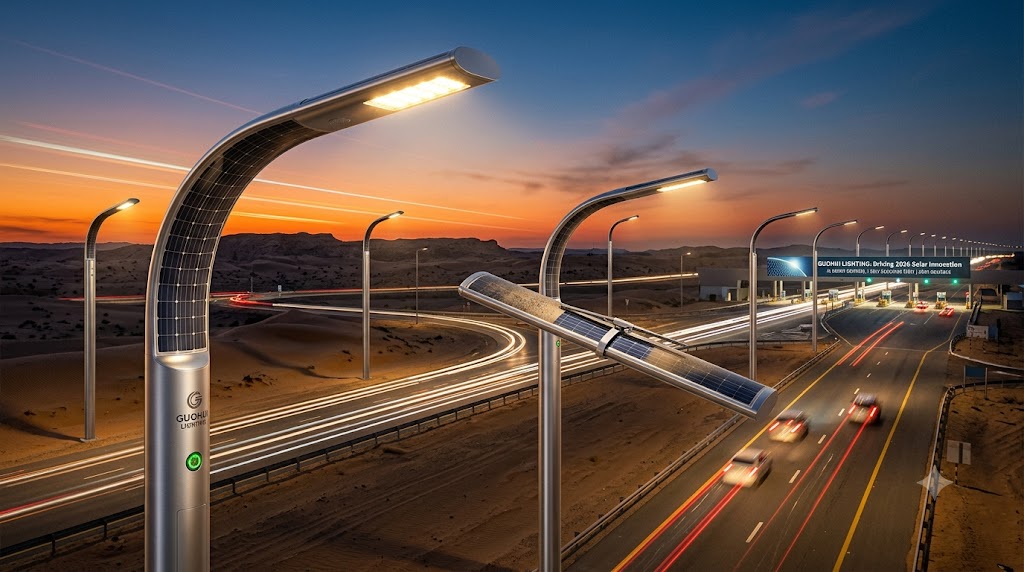
2026 has been a massive year of change for the solar street light industry. Since wrapping up the Guangzhou International Lighting Exhibition (GILE) in June, our team has been reflecting on where the market is heading.
The days of just "slapping a solar panel on a battery and hoping it works" are officially over. The industry is leveling up. Whether you are an engineer in the Middle East or a government contractor in Africa, here are the 4 biggest trends reshaping our industry right now—and why they matter for your next project.
For years, the B2B solar lighting market has been plagued by a "price war," with some suppliers exaggerating battery capacities and lumen outputs.
Well, the rules have changed. In March 2026, two new national energy efficiency standards (GB/T 24460-2025 and GB 37478-2025) officially kicked in. These strict regulations are actively weeding out low-efficiency, "fake-spec" products.
What this means for you: The market is finally shifting from "who is the cheapest" to "who provides real value." At Guohui Lighting, we love this. We’ve always insisted on transparent manufacturing, strict EL testing, and real IES reports. Now, the whole industry is being forced to meet the high standards you deserve.
Street lights used to be simple: they turn on at night and off in the morning. Not anymore.
In April 2026, the China Illuminating Engineering Society released new standards for "AI Solar Street Light Systems." These new lights act as closed-loop smart systems. They can independently monitor grid status, detect weather changes, and adjust their own dimming profiles to save battery. They even send automated fault warnings to your phone or computer. It's practically a smart brain inside a light pole!
If you install solar lights in desert regions, you know that dust accumulation on solar panels can reduce power generation by a massive 20% to 40%.
One of the coolest breakthroughs we've seen this year (which even won the 2026 Alighting Award) is the combination of Smart Self-Cleaning tech and Wi-SUN Mesh Networking.
Self-cleaning wipers automatically brush off sand and bird droppings, recovering that 20%+ power loss.
Wi-SUN technology allows these lights to "talk" to each other and form their own network. This means you can easily achieve remote control and status monitoring even in remote highways or rural areas where there is zero 4G cell signal.
We saw a lot of amazing things at GILE 2026, but the "3rd-generation solar street light" stole the show. Instead of a big, flat solar panel sitting on top of the light, the solar modules are wrapped directly around the pole in a cylindrical shape.
Why is this a game-changer?Zero wind drag. Traditional flat panels can act like a sail during heavy storms. The integrated PV pole has incredibly low wind resistance, making it the ultimate solution for coastal areas, islands, and regions prone to typhoons. Plus, the sleek, modern design has made it a massive hit for urban projects in the Middle East right now.
The solar lighting industry is getting smarter, tougher, and much more strictly regulated—which means your projects will be safer and last longer than ever before.
At Guohui Lighting, we are constantly upgrading our production lines (including our brand-new LiFePO4 battery facility!) to keep pace with these exact innovations.
Planning a highway or municipal lighting project for Q3/Q4?
Send us a message today! Let’s talk about how to integrate reliable, future-proof solar lighting into your next bid.
Product
Project
About
Contact us
7F,Bldg. A,Hytera Park,3 Baolong 4th Rd,Longgang,Shenzhen,China