

Die-Casting vs. Extrusion: Which Aluminum Process Is Better for Solar Street Lights?
2026-09-10
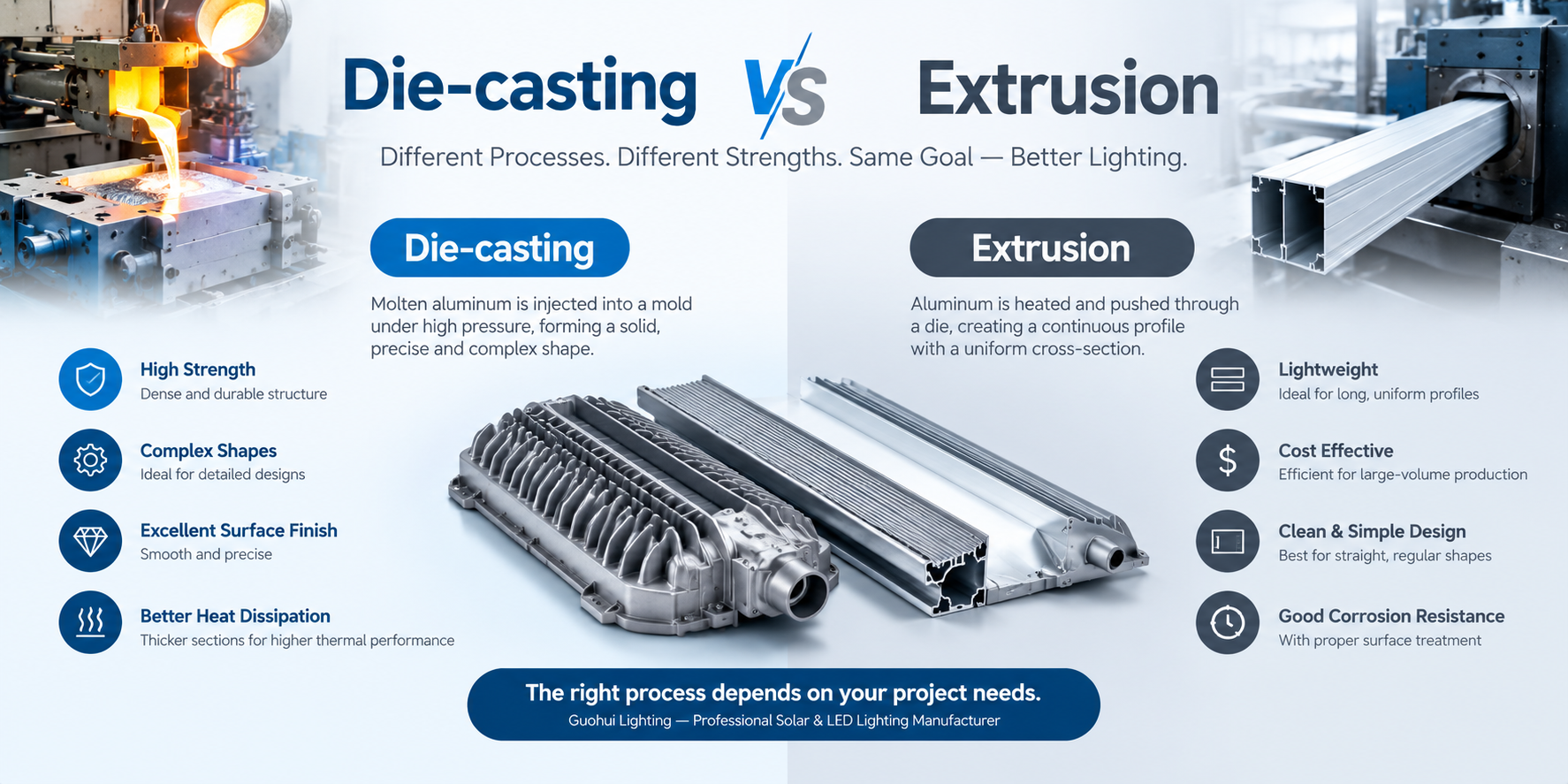
When choosing an outdoor lighting product, the appearance of the housing is only part of the story. The manufacturing process used to produce the aluminum housing can have a significant impact on its strength, heat dissipation, design flexibility, weight, and long-term performance.
Two of the most common aluminum manufacturing processes used in LED and solar lighting are die-casting and extrusion.
So, which one is better?
The answer depends on the application. At Guohui Lighting, we use different aluminum manufacturing processes according to the structure, performance requirements, and application of each lighting product.
Die-casting is a manufacturing process in which molten aluminum is injected into a specially designed mold under high pressure. Once the aluminum cools and solidifies, it forms a precise housing with the required shape and structure.
This process is particularly suitable for lighting products that require complex shapes, integrated structures, high strength, and efficient heat management.
1. Complex and integrated designs
Die-casting allows manufacturers to create detailed structures, mounting points, ribs, and heat-dissipation features within a single housing.
This makes it possible to develop compact and integrated solar street light designs without relying on multiple assembled parts.
2. High structural strength
A well-designed die-cast aluminum housing provides a strong and durable structure, which is important for outdoor lighting exposed to wind, rain, vibration, and changing weather conditions.
3. Excellent dimensional consistency
The mold determines the final shape of the product, allowing large quantities of housings to maintain consistent dimensions and appearance.
4. Efficient thermal design
Die-casting provides considerable freedom when designing heat-dissipation structures. For LED lighting, effective heat management is essential because excessive heat can affect LED efficiency and component lifespan.
Aluminum extrusion works differently. Heated aluminum is pushed through a specially designed die to create a continuous profile with a uniform cross-section.
The resulting profile can then be cut, machined, assembled, and finished according to the requirements of the lighting product.
Extrusion is widely used for long, straight, and relatively simple aluminum structures.
1. Lightweight structure
Extruded aluminum profiles can provide a good balance between structural strength and weight, making them suitable for applications where reducing overall weight is important.
2. Efficient for large-volume production
For products with a consistent cross-sectional design, extrusion can be an efficient manufacturing method, particularly for high-volume production.
3. Flexible profile design
Different dies can be developed to create specific aluminum profiles. Extrusion is especially suitable when the housing has a long and uniform shape.
4. Good heat dissipation
Aluminum itself has good thermal conductivity, and extruded profiles can incorporate fins or other structures to help transfer heat away from LED components.
| Feature | Die-Casting | Extrusion |
|---|---|---|
| Shape | Complex and integrated | Straight and uniform |
| Structural strength | High | High |
| Design flexibility | Excellent | Good |
| Heat-dissipation design | Highly flexible | Excellent for linear profiles |
| Weight | Depends on design | Generally lightweight |
| Production | Efficient for complex parts | Efficient for uniform profiles |
| Best suited for | Integrated lighting housings | Long, simple profiles |
There is no universal winner.
For an all-in-one solar street light, where the housing needs to integrate the LED module, battery compartment, mounting structure, controller area, and heat-dissipation features, die-casting can offer significant design advantages.
For a split-type solar street light or other products using longer and more regular aluminum profiles, extrusion can be a practical solution.
More importantly, the manufacturing process is only one part of the final product quality.
The quality of the aluminum alloy, housing thickness, structural design, surface treatment, heat-dissipation system, LED components, battery, solar panel, and quality control process all influence the actual performance of a solar street light.
A solar street light operates outdoors for years. During the daytime, the LED system and electronics must remain protected from environmental conditions while managing heat effectively. At night, the LED system needs to deliver stable lighting performance for the required operating period.
That is why a lighting housing should not simply be judged by its appearance.
Two solar street lights may look almost identical from the outside, but their internal structures, materials, thermal management, battery systems, and component quality can be very different.
At Guohui Lighting, we focus on the complete lighting system rather than treating the housing as an isolated component.
Die-casting and extrusion are both proven aluminum manufacturing technologies. The better choice depends on the product structure and project requirements.
For complex, integrated, and highly engineered lighting housings, die-casting offers excellent design flexibility and structural performance.
For lightweight, straight, and uniform structures, extrusion provides an efficient and practical solution.
The goal is not simply to choose the more advanced manufacturing process. The goal is to choose the right process for the right lighting application.
As a solar lighting manufacturer in China, Guohui Lighting develops and manufactures solar street lights and outdoor LED lighting solutions for projects in different markets.
From aluminum housing design and LED thermal management to LiFePO4 battery packs, solar panels, MPPT controllers, assembly, testing, and quality control, we pay attention to the details that determine long-term lighting performance.
The right process. The right materials. The right lighting solution.
Guohui Lighting — Solar Lighting Solutions.
Product
Project
About
Contact us
7F,Bldg. A,Hytera Park,3 Baolong 4th Rd,Longgang,Shenzhen,China