

High Lumen vs. High Wattage: What Really Matters in Solar Street Lighting?
2026-09-14
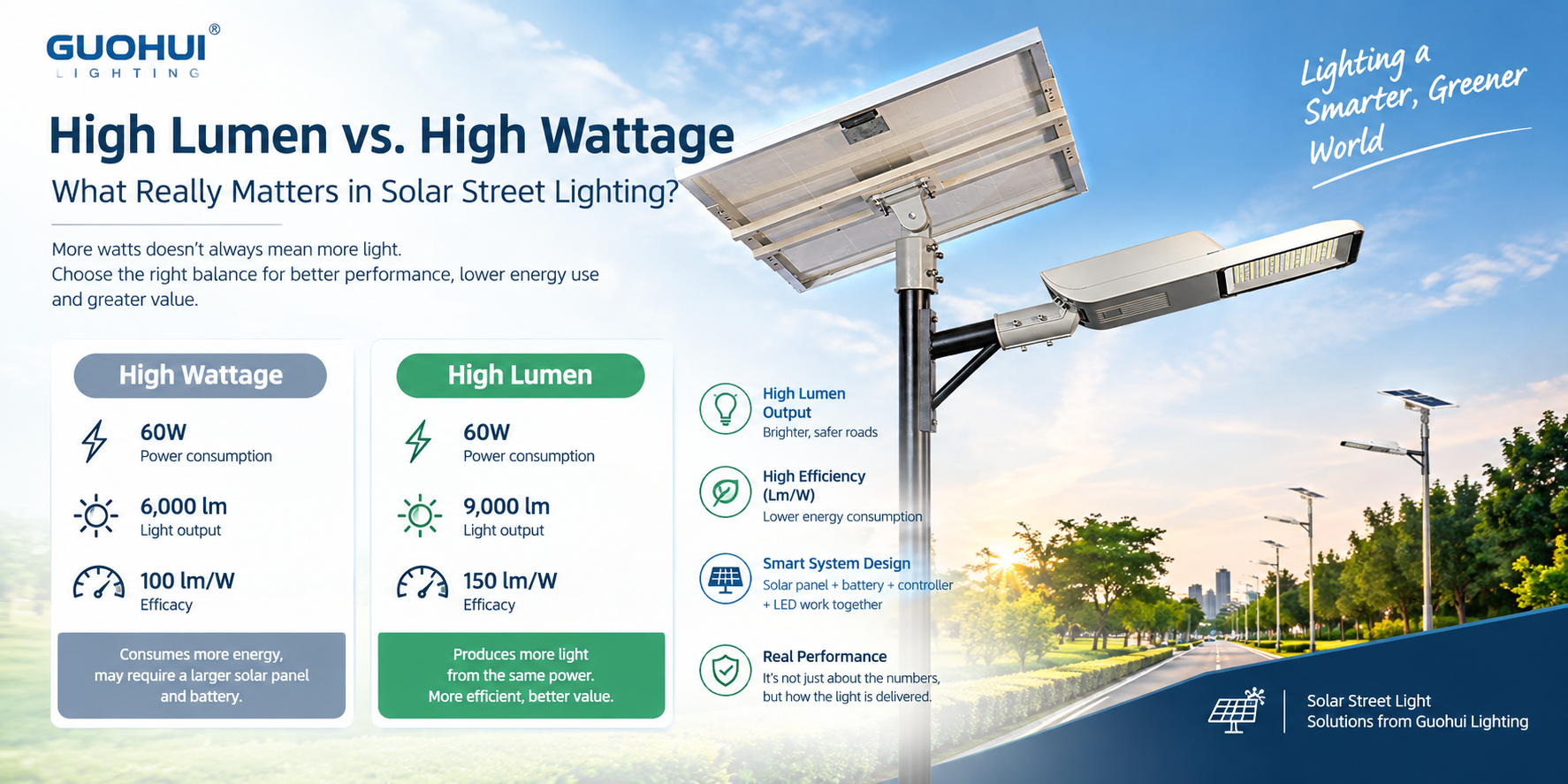
When comparing solar street lights, one question appears again and again:
Should we choose higher wattage or higher lumens?
The short answer is: neither number should be considered alone.
Watts tell you how much electrical power a luminaire consumes. Lumens tell you how much visible light it produces. The relationship between the two is expressed as luminous efficacy, measured in lumens per watt (lm/W). A higher lm/W means more light is produced from each watt of electrical power.
For solar lighting, this relationship becomes even more important because the lamp, battery and solar panel all have to work together.
At Guohui Lighting, we believe a better question is not:
“How many watts is the lamp?”
but:
“How much useful light can the system actually deliver?”
This is one of the most common misunderstandings in lighting.
Watt (W) is a measurement of electrical power consumption. It does not directly tell you how bright a lamp will be.
Lumen (lm) is a measurement of luminous flux—the total visible light output.
For example, two solar street lights may both be labeled 60W, but that does not automatically mean they provide the same amount of light.
One may produce 7,000 lumens while another produces 9,000 lumens. Their LED chips, operating current, optical design, driver efficiency, thermal management and overall luminaire design can all be different.
This is why simply comparing the wattage printed on the housing can be misleading.
The U.S. Department of Energy also distinguishes between the LED source's efficacy and the efficacy of the complete luminaire, because drivers, thermal management and optics can all affect the final performance.
The basic calculation is simple:
Luminous Efficacy = Lumens ÷ Watts
For example:
60W → 7,200 lm
7,200 ÷ 60 = 120 lm/W
Another product:
60W → 9,000 lm
9,000 ÷ 60 = 150 lm/W
Both products consume approximately the same electrical power, but the second produces more light from that power.
This is why high efficacy can be more meaningful than simply pursuing high wattage.
But there is an important detail here:
An LED chip may have a very high laboratory efficacy, but the complete street light will experience losses through the driver, PCB, optics, thermal system and other components.
For a project buyer, what matters is the actual performance of the complete luminaire, not just the theoretical performance of an individual LED chip.
With conventional grid-powered lighting, using a little more electricity may simply mean a higher electricity bill.
Solar street lighting is different.
A solar street light is an integrated energy system:
Solar Panel → Battery → Controller → LED Luminaire → Optical Distribution
Every additional watt consumed by the lamp affects the requirements of the solar panel and battery.
If the system needs to operate throughout the night, especially in areas with cloudy or rainy weather, energy management becomes critical.
A higher-wattage lamp may produce more light—but it may also require:
A larger solar panel
A larger battery
More charging capacity
A larger energy reserve
Higher system cost
Therefore, the goal should not simply be “more watts.”
The goal should be:
Enough useful light + appropriate power consumption + reliable overnight operation.
There is another trap in the opposite direction.
A product may advertise a very high lumen figure, but that does not necessarily mean it will provide better illumination on the road.
Why?
Because lumens are total light output, while a street lighting project is concerned with where the light goes.
Imagine two lamps producing the same 8,000 lumens.
One distributes the light efficiently across the road surface.
The other sends a significant amount of light outside the intended area.
On a specification sheet, they may look identical.
On the road, they may perform very differently.
This is why outdoor lighting evaluation should consider not only lumen output and efficacy, but also optical distribution and how effectively the luminaire delivers light to the target area.
For a solar street light project, factors such as:
Mounting height
Pole spacing
Road width
Beam distribution
Installation angle
Required illuminance
Uniformity
Glare
Road classification
can all influence the final lighting result.
More lumens are useful only when those lumens are delivered where they are needed.
This is something we have seen repeatedly when communicating with customers.
A buyer may ask for:
“60W solar street lights.”
That sounds straightforward.
But we normally want to understand more.
Is the 60W the actual rated input power?
Is it the maximum power?
Is it the LED chip power?
Or is it simply a model name?
And what is the actual luminous output of the complete luminaire?
These questions matter because specifications can sometimes be presented differently by different suppliers.
For example:
| Product | Rated Power | Luminous Output | Efficacy |
|---|---|---|---|
| A | 60W | 6,000 lm | 100 lm/W |
| B | 60W | 7,200 lm | 120 lm/W |
| C | 60W | 9,000 lm | 150 lm/W |
All three products can be called 60W solar street lights.
But they are not necessarily equivalent products.
For buyers comparing suppliers, asking for both actual power and actual lumen output provides a much clearer basis for comparison.
Instead of asking only:
“How many watts?”
we recommend requesting a more complete set of technical information.
Ask for the actual rated input power of the complete lamp.
Ask for the actual lumen output rather than relying only on the LED chip specification.
Calculate:
lm/W = Lumens ÷ Actual Power
For road lighting projects, ask for the photometric file and distribution information when available.
For example:
2700K / 3000K / 4000K / 5000K / 5700K
The appropriate color temperature depends on the project and application.
A 40W lamp installed at 5 meters is not equivalent to a 40W lamp installed at 8 meters.
The pole height, spacing and road width should always be considered together with the luminaire specifications.
At Guohui Lighting, we don't believe in making a product look better simply by putting a larger number on the specification sheet.
A successful solar street lighting system should balance several things:
Light output
Energy efficiency
Optical distribution
Battery capacity
Solar charging capacity
Thermal management
Environmental durability
Project requirements
That is why the best solar street light is not necessarily the one with the highest wattage or the highest advertised lumen figure.
It is the one that provides the right amount of useful light with the right energy consumption for the actual application.
A solar street light specification is only the beginning.
The real test comes after installation.
For a project, we need to think about questions such as:
How high is the pole?
How far apart are the poles?
How wide is the road?
How many hours of lighting are required?
What are the local weather conditions?
How many consecutive rainy days should the system support?
What lighting level and uniformity are required?
These questions help determine whether a particular combination of wattage, lumen output, battery capacity and solar panel size is appropriate.
This is also why Guohui Lighting approaches solar lighting as a system solution, rather than simply selling a lamp with a wattage label.
So, which is better?
High lumen?
High wattage?
The answer is neither by itself.
For solar street lighting, what really matters is the relationship between lumens, watts, efficacy, optical distribution and system energy capacity.
A higher-wattage lamp can be the right choice when a project genuinely requires more light.
A high-efficacy lamp can be the better choice when the project needs to achieve the required lighting level while keeping energy consumption under control.
And in many projects, the best solution is somewhere in between.
Don't buy the biggest number.
Understand what the number actually means.
At Guohui Lighting, we focus on real specifications, practical system design and reliable performance—because a solar street light should not only look powerful on paper.
It should perform when the sun goes down.
Product
Project
About
Contact us
7F,Bldg. A,Hytera Park,3 Baolong 4th Rd,Longgang,Shenzhen,China